
Your mattress collects sweat, dead skin cells, dust mites, and bacteria every single night. Most people never clean it. The result? Allergies, odors, and a sleeping surface that’s far less hygienic than it looks. The good news: cleaning a mattress takes less than an hour and only requires a few basic supplies.
This guide walks you through every step — from vacuuming and stain removal to deodorizing and drying — plus how often you should clean based on your mattress type.
Key Takeaways
- Vacuum your mattress every 1 to 3 months to remove dust mites, dead skin, and allergens.
- Baking soda is your best deodorizer — sprinkle it on, leave it for 8 hours, then vacuum it off.
- Cold water removes fresh stains better than hot — heat sets protein stains like blood and sweat permanently.
- Memory foam and latex mattresses need less moisture — never soak them or use a steam cleaner directly.
- A mattress protector cuts cleaning frequency in half and extends the life of your mattress significantly.
- Deep clean your mattress at least twice a year, more often if you have pets, allergies, or young children.
What Supplies Do You Need to Clean a Mattress?

Quick Answer: You need a vacuum with an upholstery attachment, baking soda, cold water, dish soap or white vinegar, a spray bottle, clean cloths, and an enzyme cleaner for biological stains like urine or blood. Most supplies cost under $15 total.
Before you start, gather everything so you’re not stopping mid-clean. Here’s what works for most mattress types:
- Vacuum cleaner with an upholstery or crevice attachment
- Baking soda (a full box for a queen or king size)
- Cold water in a spray bottle
- Mild dish soap or white vinegar
- Enzyme cleaner (for urine, blood, vomit)
- Clean white cloths or paper towels
- Optional: Essential oil (a few drops added to baking soda for scent)
Avoid soaking the mattress with any liquid. Excess moisture trapped inside can cause mold to grow, especially in memory foam and innerspring mattresses with layers of padding.
How Do You Vacuum a Mattress Properly?
Quick Answer: Use an upholstery attachment and vacuum in overlapping rows across the entire surface. Work slowly — about 2 inches per second — to pull out dust mites, skin cells, and debris. Then vacuum the sides and edges using a crevice tool.
Step 1: Strip and Wash the Bedding First
Remove all pillowcases, sheets, and mattress protectors before vacuuming. Wash them in hot water (at least 130°F / 54°C) to kill dust mites. While those run through the wash, work on the mattress itself.
Step 2: Vacuum Every Surface
Start at the top of the mattress and work in straight, overlapping rows down to the foot. Use slow, deliberate strokes. Moving too fast misses most of the debris sitting in fabric fibers and seams.
Switch to a crevice tool for the seams along all four sides. Dust mites accumulate heavily in these seams. Don’t skip them.
Step 3: Flip or Rotate (If Applicable)
After vacuuming the top, check whether your mattress can be flipped. Most modern mattresses are one-sided and should not be flipped — only rotated 180 degrees. Innerspring mattresses can often be flipped. Check your mattress label or manufacturer instructions.
How Do You Remove Stains From a Mattress?

Quick Answer: Blot the stain with cold water first. Then apply a cleaning solution — dish soap and water for general stains, enzyme cleaner for biological stains like urine or blood. Blot again, never scrub. Let it air dry completely before replacing bedding.
General Stains (Food, Sweat, Dirt)
Mix one teaspoon of mild dish soap with two cups of cold water. Dampen a clean white cloth with the solution and blot the stain from the outside edge toward the center. This prevents the stain from spreading outward.
Never rub or scrub. Rubbing pushes the stain deeper into the mattress fibers and makes it larger. Blot, lift, blot again.
Urine Stains
Urine contains uric acid crystals that regular soap won’t fully break down. An enzyme cleaner — a product with biological enzymes that digest organic matter — is the most effective option. Spray it on, let it sit for 10 to 15 minutes, then blot dry.
For old, dried urine stains, mix equal parts white vinegar and cold water in a spray bottle. Lightly spray the area, let it sit for 5 minutes, then blot. Follow with baking soda to absorb leftover moisture and odor.
Blood Stains
Always use cold water on blood. Hot water causes the proteins in blood to bond with fibers permanently. Blot the stain with cold water first. Then apply a small amount of 3% hydrogen peroxide (the kind from a pharmacy) directly to the stain. It will fizz — that’s normal. Blot it away and repeat until the stain fades.
Test hydrogen peroxide on a hidden corner first. It can lighten some fabric colors.
Mattress Stain Removal Reference
| Stain Type | Best Cleaning Agent | Water Temperature | Soak Time | Key Caution |
|---|---|---|---|---|
| Sweat / Body Oil | Dish soap + cold water | Cold | 3 to 5 min | Blot only, do not scrub |
| Urine (fresh) | Enzyme cleaner | Cold | 10 to 15 min | Do not use hot water |
| Urine (dried) | Vinegar + water 50/50 | Cold | 5 to 10 min | Follow with baking soda |
| Blood (fresh) | Cold water, then hydrogen peroxide 3% | Cold only | 2 to 3 min | Avoid hot — sets stain |
| Blood (dried) | Hydrogen peroxide 3% | Cold | 5 min per pass | Test on hidden area first |
| Food / Drink | Dish soap + cold water | Cold | 3 to 5 min | Remove solids first |
| Vomit | Enzyme cleaner | Cold | 10 to 15 min | Remove solids before treating |
How Do You Deodorize a Mattress With Baking Soda?
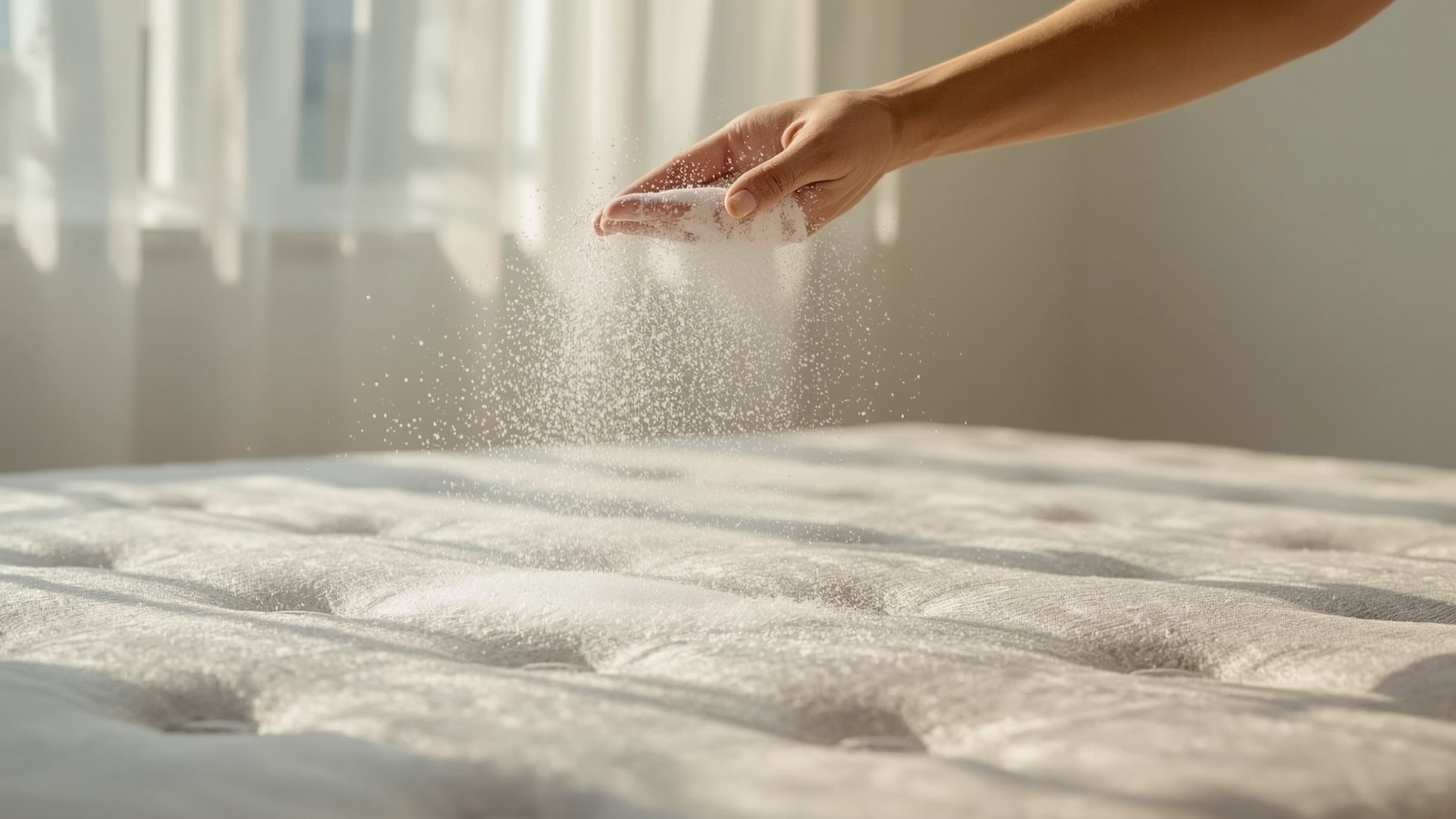
Quick Answer: Sprinkle a generous, even layer of baking soda across the entire mattress surface. Leave it on for at least 8 hours — overnight is ideal. The baking soda absorbs moisture and neutralizes odor-causing acids. Then vacuum it all off completely.
The Baking Soda Method (Step by Step)
- After removing any stains, let the surface dry completely before applying baking soda.
- Open a full box of baking soda and sift it evenly across the mattress surface using your hand or a sieve.
- For added scent, mix 10 to 15 drops of lavender or eucalyptus essential oil into the baking soda before sprinkling.
- Leave the baking soda on for a minimum of 8 hours. The longer it sits, the more odor it pulls out.
- Vacuum the baking soda off thoroughly using the upholstery attachment. Go slowly and cover every inch.
Baking soda works because it is a base (alkaline). Sweat and body odors are acidic. The two neutralize each other on contact, which eliminates the smell rather than just masking it.
What If the Mattress Smells Like Mildew?
A mildew smell usually means moisture got trapped inside the mattress. Lightly spray the surface with undiluted white vinegar, then let it air dry in a well-ventilated room or in direct sunlight for several hours. Follow with the baking soda treatment above.
If the mildew smell persists after two treatments, the moisture damage may be too deep to reverse. This is a sign the mattress may need to be replaced.
How Long Does a Mattress Take to Dry After Cleaning?
Quick Answer: A lightly cleaned mattress dries in 2 to 4 hours. A deeply treated mattress with significant liquid application needs 6 to 8 hours of air drying. Use fans, open windows, or place it in direct sunlight to speed drying. Never put bedding back on a damp mattress.
Putting sheets back on a damp mattress is the most common mistake people make. Trapped moisture inside a mattress creates a perfect environment for mold and mildew. Mold inside a mattress cannot be remediated — it means replacement.
How to Speed Up Drying
- Point a box fan or stand fan directly at the mattress surface
- Open windows to increase air circulation in the room
- Move the mattress to a spot with direct sunlight if possible (UV light also kills bacteria)
- Use a hairdryer on a low setting for spot-treated areas — keep it moving, never hold it in one spot
How Often Should You Clean Your Mattress?
Quick Answer: Most mattresses should be deep cleaned at least twice a year. Mattresses used by children, pets, or allergy sufferers need cleaning every 1 to 3 months. Memory foam and latex mattresses should be vacuumed monthly but treated with minimal moisture during deep cleans.
Cleaning Frequency by Mattress Type
| Mattress Type | Full Deep Clean | Vacuuming | Moisture Tolerance | Can It Be Flipped? |
|---|---|---|---|---|
| Innerspring | Every 6 months | Every 1 to 2 months | Moderate — dry fully | Yes (double-sided models) |
| Memory Foam | Every 6 months | Every 1 to 2 months | Low — minimal moisture | No |
| Latex | Every 6 to 12 months | Every 2 to 3 months | Low — spot clean only | Some models, check label |
| Hybrid | Every 6 months | Every 1 to 2 months | Moderate — dry fully | No |
| Pillow-Top | Every 3 to 6 months | Every month | Low — extra padding traps moisture | No |
| Waterbed / Air Mattress | Surface only, as needed | Monthly wipe-down | Surface clean with damp cloth | No |
When Should You Clean More Often?
Some situations call for more frequent cleaning, regardless of mattress type:
- Pets sleep on the bed: Clean every 4 to 6 weeks — pet dander and hair accelerate allergen buildup
- Young children or babies: Clean every 4 to 8 weeks due to higher risk of accidents
- Allergy or asthma sufferers: Vacuum monthly and deep clean every 3 months
- After illness: Deep clean immediately — bacteria and viruses can survive on fabric surfaces
- After a guest stay: Quick vacuum and baking soda treatment before next use
What Is the Best Way to Clean a Memory Foam Mattress?
Quick Answer: Spot clean memory foam with a lightly dampened cloth and mild soap. Never saturate it with liquid, never use a steam cleaner, and never put it in direct contact with heat. Memory foam absorbs moisture deeply and dries very slowly, which creates mold risk.
Memory Foam Cleaning Rules
Memory foam — a viscoelastic polyurethane foam that conforms to body shape — has a dense, open-cell structure. That structure is excellent for pressure relief but terrible at shedding moisture. Here’s what to keep in mind:
- Use a spray bottle set to mist, not stream, to apply any liquid
- Blot stains immediately and use as little liquid as possible
- Dry with a fan for at least 6 to 8 hours after any cleaning
- Avoid steam cleaners entirely — the heat can break down foam cells
- Baking soda is safe and effective on memory foam — vacuum it off thoroughly
Does a Mattress Protector Reduce How Often You Need to Clean?
Quick Answer: Yes. A waterproof mattress protector blocks liquids, allergens, and dust mites from reaching the mattress surface. With a protector, you only need to deep clean the mattress once or twice a year instead of monthly. Wash the protector every 2 months.
Mattress Protector Types Compared
| Protector Type | Waterproof | Dust Mite Barrier | Typical Cost | Wash Frequency |
|---|---|---|---|---|
| Fitted Sheet Style | No | Partial | $15 to $30 | Monthly |
| Waterproof Fitted | Yes | Yes | $25 to $60 | Every 2 months |
| Encasement (full zip) | Yes | Full barrier | $40 to $100 | Every 3 to 6 months |
| Cooling Protector | Yes (most models) | Yes | $50 to $120 | Every 2 months |
A full encasement protector — one that zips completely around the mattress — provides the strongest barrier against dust mites, allergens, and bed bugs. It’s the best choice for allergy sufferers or households with children.
What Are the Signs That a Mattress Needs Replacing Instead of Cleaning?
Quick Answer: Replace your mattress if it has visible mold, persistent odor after two deep cleans, sagging deeper than 1.5 inches, or is over 8 to 10 years old. Cleaning cannot fix structural damage, deep mold growth, or permanent material breakdown.
Mattress Lifespan by Type
| Mattress Type | Average Lifespan | Replace If… |
|---|---|---|
| Innerspring | 5 to 8 years | Coils poking through, sagging over 1.5 inches |
| Memory Foam | 8 to 10 years | Permanent body impressions, loss of support |
| Latex (natural) | 10 to 15 years | Crumbling, severe sagging, latex smell change |
| Hybrid | 7 to 10 years | Coil noise, foam layer breakdown |
| Pillow-Top | 5 to 7 years | Pillow layer flattened, uneven sleeping surface |
How Do You Clean a Mattress After Bed Bug Treatment?
Quick Answer: After professional bed bug treatment, vacuum the mattress thoroughly, wipe the surface with a lightly damp cloth, and encase it in a bed bug-proof encasement mattress protector immediately. Do not use DIY sprays — they rarely penetrate deep enough to reach all bugs.
Bed bugs — small parasitic insects roughly 4 to 5mm long — hide in mattress seams, box springs, and bed frames. Cleaning alone cannot eliminate an infestation. Professional heat treatment or insecticide treatment by a licensed pest control operator is necessary first. Post-treatment cleaning removes dead bugs, eggs, and chemical residue from the surface.
Can You Steam Clean a Mattress?
Quick Answer: You can steam clean innerspring and hybrid mattresses, but you should avoid steam on memory foam and latex. Steam penetrates fabric and kills dust mites and bacteria, but it also pushes moisture deep into the mattress. Drying time after steam cleaning is 4 to 8 hours minimum.
Steam Cleaning: When It Works and When It Doesn’t
A handheld steam cleaner uses water heated to 212°F (100°C) to sanitize surfaces. The heat kills dust mites, bacteria, and mold spores on contact. For innerspring mattresses with firm, dense construction, this works well if you keep the steamer moving and don’t saturate any one spot.
For memory foam, the heat degrades the foam’s cellular structure over time, and the moisture has nowhere to go quickly. Stick to the baking soda and spot-clean method for foam-based mattresses.
Frequently Asked Questions
Can you use a carpet cleaner or wet vac on a mattress?
A wet/dry vacuum can help extract moisture after treating a stain, which is useful. A full carpet cleaning machine that injects water into the surface is not recommended — it introduces too much moisture and dramatically increases drying time and mold risk.
How do you get rid of dust mites in a mattress?
Wash bedding in hot water (130°F / 54°C) weekly. Vacuum the mattress monthly using an upholstery attachment. Use a dust mite-proof encasement protector. Dust mites thrive in humidity above 50%, so keeping your bedroom humidity below 50% also reduces their population significantly.
Is it safe to use bleach on a mattress?
No. Bleach damages fabric fibers and the foam layers beneath them. It also leaves a harsh residue that is unsafe to sleep on. Use hydrogen peroxide at 3% concentration as a safer alternative for whitening or disinfecting stained areas.
What is the fastest way to clean a mattress if you need it done same day?
Vacuum the surface, spot-treat any visible stains with cold water and dish soap, then sprinkle baking soda and run a fan directly at the mattress for 4 hours. Vacuum off the baking soda. This gets you a reasonably clean, dry, odor-reduced mattress in about 5 to 6 hours total.
How do you clean a mattress topper?
Most mattress toppers should be spot-cleaned the same way as the mattress itself — blot stains, use baking soda for odors, and air dry fully. Thin cotton or polyester toppers can often be machine washed on a gentle cycle in cold water. Always check the care label first.
Does sunlight actually help clean a mattress?
Yes. UV rays from direct sunlight kill bacteria and dust mites on the mattress surface. Placing a mattress in direct sunlight for 3 to 4 hours also speeds drying significantly after cleaning. This works best on a dry, low-humidity day — avoid doing it when the outdoor humidity is above 60%.


