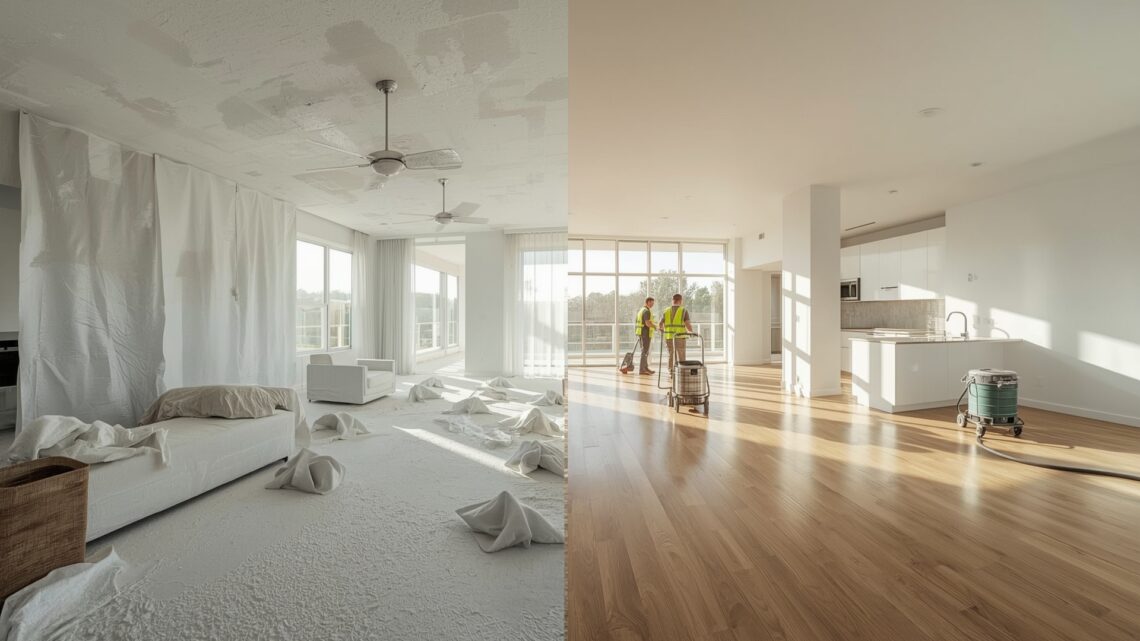
After construction or a major renovation, the job isn’t done when the last nail goes in. Dust coats every surface. Debris fills the corners. Adhesive residue clings to windows. The space looks like a construction zone because it was one. Post-construction cleaning transforms that raw, dusty shell into a space that’s actually livable or ready for business.
This guide covers everything you need to know: what the cleaning process involves, how it’s different from a standard or deep clean, what a professional crew does on-site, and how much it costs for new builds or renovation projects.
Key Takeaways
- Post-construction cleaning is a three-phase process that includes rough clean, light clean, and final clean.
- It’s not the same as a deep clean. Construction cleaning removes building debris, adhesives, drywall dust, and paint overspray — tasks standard cleaning services don’t handle.
- Professional crews use specialized tools and chemicals that residential cleaners typically don’t carry, including scrapers, HEPA vacuums, and commercial degreasers.
- Costs typically range from $0.15 to $0.50 per square foot for residential projects, depending on scope, region, and condition.
- DIY post-construction cleaning is possible for small renovations but impractical for full builds due to the volume of debris and health risks from fine particulate dust.
- Timing matters. Scheduling the clean too early — before all trades finish — forces a repeat clean and wastes money.
What Is Post-Construction Cleaning?
Quick Answer: Post-construction cleaning is the removal of construction debris, dust, adhesive residue, and surface contaminants left after building or renovation work. It prepares a space for occupancy, inspection, or handover and is done in phases as work progresses.
Every construction project, from a kitchen remodel to a full commercial build, leaves behind a specific type of mess. It’s not regular dirt. It’s fine drywall dust that penetrates every crack. It’s paint drips on windows. It’s grout haze on tile floors. It’s sawdust packed into HVAC vents.
Post-construction cleaning (also called post-build cleaning or builder’s clean) is the systematic process of removing all of that. It’s performed after the construction crew leaves and before the space is handed over to the owner, tenant, or occupant.
The goal isn’t just cleanliness. It’s safety and readiness. Fine construction dust contains silica particles (from concrete and drywall), wood dust, and other materials that cause respiratory problems. A proper post-construction clean protects the people who move in next.
How Does Post-Construction Cleaning Differ from Deep Cleaning?
Quick Answer: Deep cleaning targets built-up grime in a lived-in home. Post-construction cleaning removes building materials and residues like drywall dust, adhesives, and paint overspray. They use different tools, chemicals, and skill sets — one does not replace the other.
This is one of the most common points of confusion when hiring a cleaning service. A deep clean is intensive, but it’s designed for a home that people have been living in. It focuses on soap scum, grease buildup, limescale, and general neglect.
Post-construction cleaning deals with a completely different category of mess. Construction sites generate hazardous fine dust, chemical residues, and physical debris. Cleaning that up requires scrapers, HEPA-filter vacuums (which trap particles as small as 0.3 microns), commercial-grade degreasers, and specific chemical agents for adhesive removal.
Most standard residential cleaning companies will decline post-construction work or charge significantly more for it. The equipment investment alone is the main reason.
Post-Construction Cleaning vs. Deep Cleaning: Key Differences
| Factor | Post-Construction Cleaning | Deep Cleaning |
|---|---|---|
| Primary debris type | Drywall dust, adhesives, paint, grout haze | Grease, soap scum, limescale, built-up dirt |
| Equipment required | HEPA vacuums, scrapers, commercial degreasers | Standard vacuums, mops, scrubbing tools |
| Safety concerns | Silica dust, chemical residues, sharp debris | Standard household chemical handling |
| Who typically performs it | Specialized post-construction cleaning crews | General residential cleaning services |
| When it’s done | After trades finish, before occupancy | Periodically throughout normal home use |
| Cost per sq ft (residential) | $0.15 to $0.50 | $0.06 to $0.20 |
What Are the Three Phases of a Post-Construction Clean?
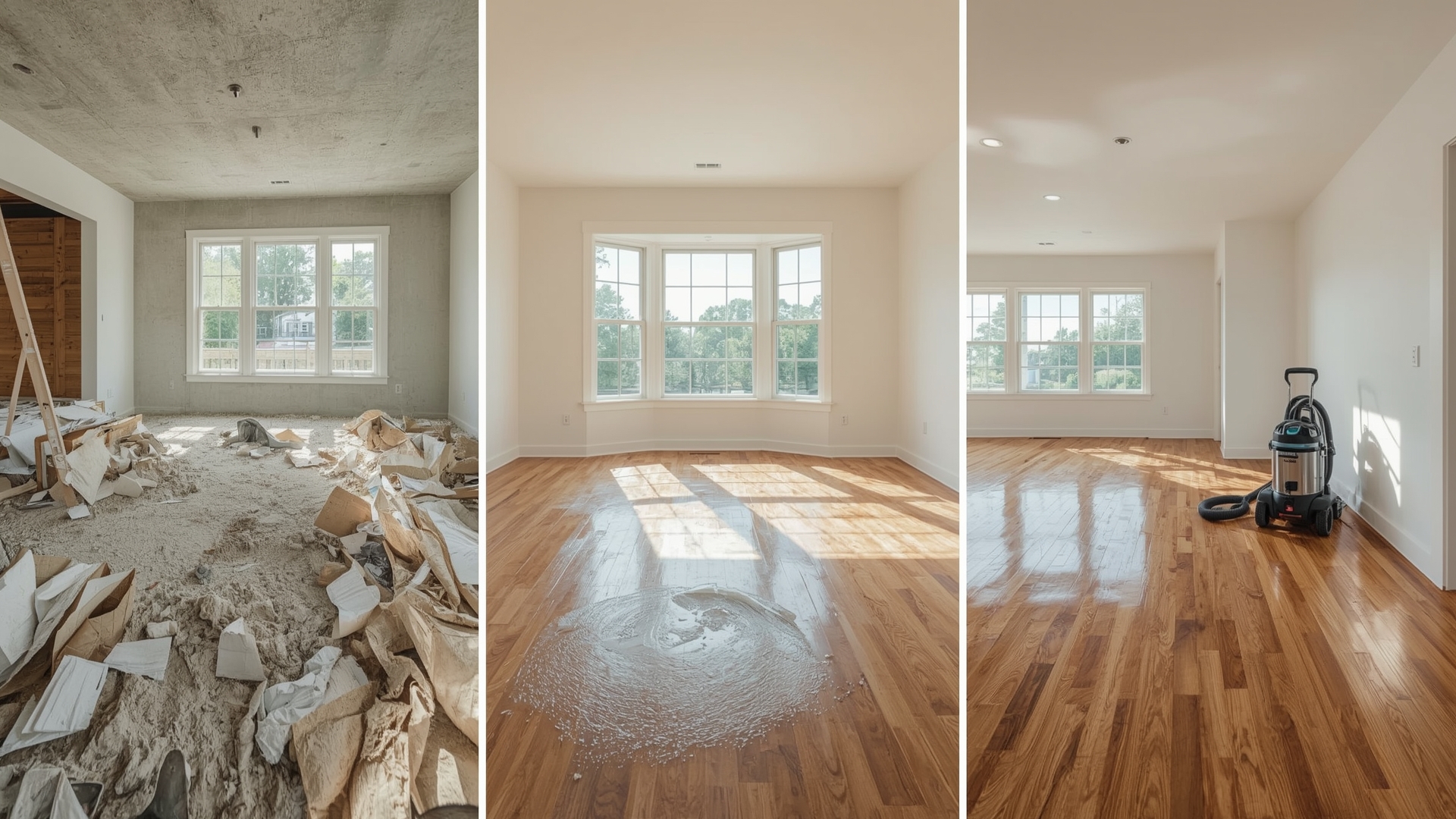
Quick Answer: Post-construction cleaning happens in three phases: the rough clean removes bulk debris during construction, the light clean addresses surfaces after trades finish, and the final clean polishes everything before handover. Each phase happens at a different point in the build timeline.
Phase 1: Rough Clean
The rough clean happens while construction is still underway. As each trade finishes its section — framing, drywall, HVAC rough-in — the rough clean crew removes large debris. This includes scrap lumber, drywall off-cuts, packaging materials, and anything that could become a hazard.
This phase is about safety and workspace maintenance. It’s not about making the space presentable. Think of it as job site waste management rather than cleaning.
Phase 2: Light Clean
The light clean (sometimes called the construction clean) happens after all major trades have finished. At this stage, drywall is taped and painted, flooring is installed, and fixtures are in place. The crew vacuums and wipes down all surfaces to remove the first wave of drywall dust.
This phase is important but temporary. Drywall dust settles continuously for days after sanding. That’s why the light clean is always followed by a final clean, not the other way around.
Phase 3: Final Clean
The final clean is the most thorough phase. It happens after everything has settled — typically 24 to 72 hours after the light clean. This is what most homeowners picture when they imagine a post-construction clean. The crew does a complete top-to-bottom clean of every surface, fixture, appliance, and floor.
This phase prepares the space for occupancy, photography, or handover inspection.
What Does a Professional Post-Construction Clean Include?

Quick Answer: A professional post-construction clean includes removing construction dust from all surfaces, cleaning windows and glass of paint and adhesive, scrubbing bathrooms and kitchens, cleaning inside cabinets and fixtures, and vacuuming and mopping all floors. The scope depends on the contract agreed before the job.
Interior Surfaces and Walls
Every surface gets dusted and wiped down. This includes walls, ceilings, baseboards, door frames, and trim. Drywall dust clings to walls even after painting, so crews use microfiber cloths and low-static cloths designed to trap fine particles rather than spread them.
Windows and Glass
Windows are one of the most time-intensive parts of a post-construction clean. Crews remove paint overspray, adhesive labels, silicone residue from caulking, and construction film from all glass surfaces. Razor scrapers and commercial glass cleaner are standard tools here.
Floors
Floor cleaning varies by material. Hardwood floors get vacuumed with a soft-attachment HEPA vacuum first, then cleaned with a product appropriate for the finish. Tile floors require grout haze removal, which involves a specific acid-based or pH-neutral cleaner applied carefully to avoid damaging grout. Carpet, if present, gets vacuumed multiple times to pull out embedded drywall dust.
Kitchens and Bathrooms
These rooms get the deepest attention. Inside cabinets and drawers are wiped out. Appliances get exterior cleaning and sometimes interior cleaning if they were installed during the build. Fixtures are polished. Sinks, countertops, and backsplashes are scrubbed and dried to prevent water spots on new surfaces.
HVAC Vents and Fixtures
Vent covers and registers are removed, wiped down, and reinstalled. Light fixtures and ceiling fans are cleaned of dust and debris. This step is often skipped by inexperienced crews, which means the first time the system runs, it blows construction dust back into the clean space.
Post-Construction Cleaning Task Coverage by Area
| Area | Tasks Included | Specialized Tools Used | Common Issues Found |
|---|---|---|---|
| Windows and glass | Paint removal, adhesive removal, streak-free finish | Razor scraper, commercial glass cleaner | Paint overspray, caulk smears |
| Floors (tile) | Grout haze removal, mopping, edge cleaning | pH-neutral or acid-based grout cleaner | Grout haze, thinset residue |
| Floors (hardwood) | HEPA vacuuming, damp mopping with wood-safe cleaner | Soft-brush HEPA vacuum | Fine dust embedded in grain |
| Walls and ceilings | Dusting, spot cleaning, scuff removal | Extension duster, microfiber cloths | Drywall dust, caulk smears |
| Kitchens | Cabinet interiors, appliance exteriors, countertops | Degreaser, microfiber cloths | Adhesive labels, construction residue |
| HVAC vents | Cover removal, interior wipe, reinstall | Screwdriver, damp cloth | Drywall dust packed into registers |
What Equipment Do Post-Construction Cleaning Crews Use?
Quick Answer: Professional post-construction crews use HEPA-filter vacuums, industrial wet-dry vacuums, razor scrapers, microfiber cloths, commercial degreasers, and acid-based grout cleaners. This equipment is purpose-built for construction residues and isn’t part of a standard cleaning kit.
The equipment distinction matters because it directly affects results. A standard vacuum recirculates fine drywall dust back into the air. A HEPA vacuum captures particles down to 0.3 microns and contains them.
Industrial wet-dry vacuums handle bulk debris and liquids that would destroy a residential vacuum. Razor scrapers safely remove hardened paint and adhesive from glass without scratching. These aren’t items a homeowner typically has on hand, which is one of the strongest arguments for hiring a specialized crew.
Standard Post-Construction Cleaning Equipment
| Equipment | Purpose | Why Standard Equipment Falls Short |
|---|---|---|
| HEPA vacuum (0.3 micron filter) | Captures fine drywall and silica dust | Regular vacuums recirculate fine particles into the air |
| Industrial wet-dry vacuum | Removes bulk debris and wet materials | Home models lack suction capacity and clog quickly |
| Razor scraper | Removes hardened paint and adhesive from glass | Chemical solvents alone won’t remove cured adhesive |
| Commercial degreaser | Breaks down adhesive residue on hard surfaces | Consumer degreasers are too diluted for construction residues |
| Acid-based tile cleaner | Dissolves grout haze on new tile | All-purpose cleaners don’t break down mineral deposits in grout haze |
| Extension pole duster | Reaches ceiling debris and high corners | Standard dusters leave fine particles airborne |
How Much Does Post-Construction Cleaning Cost?

Quick Answer: Post-construction cleaning costs $0.15 to $0.50 per square foot for residential projects. A 2,000-square-foot home typically costs $300 to $1,000. Commercial projects run higher at $0.20 to $0.80 per square foot due to larger scope and safety requirements.
Pricing in this industry is almost always calculated per square foot because the work is directly tied to surface area. A flat hourly rate is less common but does appear with smaller jobs or add-on services.
What Factors Affect the Final Price?
The condition of the site matters as much as the size. A new build where contractors kept a reasonably tidy site will be faster and cheaper to clean than a gut renovation with months of accumulated debris. Other factors that push costs up include the number of windows, the presence of tile floors requiring grout haze removal, and whether the job requires multiple phase visits.
Regional labor rates also play a significant role. Crews in major metro areas like New York, Los Angeles, or San Francisco charge more than crews in mid-size cities or rural areas. The gap can be 30 to 50 percent between markets.
Post-Construction Cleaning Cost by Project Type
| Project Type | Typical Size | Price Range | Notes |
|---|---|---|---|
| Single room renovation | 100–300 sq ft | $100–$200 | Often done as add-on to existing service |
| Full kitchen or bathroom remodel | 200–500 sq ft | $150–$300 | Grout haze removal adds cost on tile-heavy jobs |
| Residential new build (small) | 1,000–1,500 sq ft | $250–$700 | All three phases typically required |
| Residential new build (large) | 2,500–4,000 sq ft | $600–$2,000 | Window count and floor types affect cost significantly |
| Commercial build-out (small) | 1,000–3,000 sq ft | $400–$1,500 | May require licensed crew for safety compliance |
| Commercial build-out (large) | 5,000–20,000 sq ft | $1,500–$10,000+ | Multi-day jobs, specialized floor care often needed |
Can You Do Post-Construction Cleaning Yourself?
Quick Answer: DIY post-construction cleaning is realistic for small single-room renovations but not for full builds or gut renovations. Fine drywall dust poses a silica inhalation risk, and without a HEPA vacuum, you’ll just redistribute the dust rather than remove it.
For a minor project — a painted hallway or a replaced bathroom vanity — you can handle the cleanup yourself with the right approach. Rent a HEPA vacuum from a tool rental store rather than using your household vacuum. Wear an N95 respirator mask. Wipe surfaces from top to bottom so dust falls to the floor and gets vacuumed last.
For anything larger, the math shifts quickly. The time required, the equipment rental cost, and the health risks from prolonged exposure to fine silica dust make professional cleaning a better value. A crew of two or three can clean a 2,000-square-foot home in six to ten hours. The same job DIY, done properly, takes most homeowners a full weekend.
DIY vs. Professional Post-Construction Cleaning: When to Choose Each
| Scenario | Recommended Approach | Reason |
|---|---|---|
| Single painted room | DIY with rented HEPA vacuum | Limited scope, manageable with proper equipment |
| Tile floor installation | Professional (or DIY with acid cleaner) | Grout haze requires specific chemicals and technique |
| Full kitchen or bathroom remodel | Professional | Multiple surface types, adhesive and paint removal needed |
| New residential build | Professional | Volume of dust, silica risk, three-phase coordination needed |
| Commercial renovation | Professional (licensed crew) | Safety compliance, liability, and scale requirements |
When Should You Schedule Post-Construction Cleaning?
Quick Answer: Schedule your post-construction clean after all trades have left the site and no further work is planned. Starting too early wastes money because new debris immediately re-contaminates cleaned areas. The final clean should be 24 to 72 hours after the light clean to allow settled dust to be captured.
Timing is one of the most common mistakes on construction and renovation projects. Homeowners eager to move in sometimes push for a clean before flooring is fully installed or before painters have finished touch-ups. Every trade that returns after a clean undoes part of that work.
The safest approach is to confirm with your general contractor that all subcontractors have signed off before booking the final clean. If a single plumber still needs to return to install a fixture, wait. One more day before the clean saves you from paying for it twice.
How Do You Choose a Post-Construction Cleaning Service?
Quick Answer: Choose a service that specializes in post-construction cleaning, not general cleaning. Verify they use HEPA vacuums, carry liability insurance, and provide a written scope of work before starting. Ask for references from recent construction clients specifically.
The biggest mistake people make here is hiring a general residential cleaning company for a construction clean. The crew may do their best, but without HEPA vacuums and commercial-grade equipment, the job won’t be done properly. Fine drywall dust will remain in carpets, vents, and on surfaces even after the space looks clean to the eye.
Look for companies that list post-construction cleaning as a dedicated service, not as an add-on. Ask them directly: do you use HEPA vacuums? How do you handle grout haze removal? What’s your process for window glass with paint overspray? Their answers will tell you whether they have genuine experience or are just adding the service to win the job.
Questions to Ask Before Hiring a Post-Construction Cleaning Crew
- Do you use HEPA-filter vacuums on every job?
- Are you insured for damage to new surfaces and finishes?
- Do you provide a written scope of work before starting?
- How do you price the job — per square foot or hourly?
- Have you cleaned projects similar in size and scope to mine?
- What is not included in your standard post-construction clean?
- Do you handle all three phases or just the final clean?
What Should You Check After a Post-Construction Clean?
Quick Answer: After the clean, check window glass for streaks and adhesive residue, run your hand along baseboards and door frames for remaining dust, inspect tile floors for grout haze, open cabinet interiors, and check vent covers are correctly reinstalled. Do this before releasing final payment.
A walkthrough inspection is a standard part of any professional post-construction cleaning contract. Go room by room with a specific checklist rather than a general impression. Construction cleaning is one area where “looks pretty good” can hide real problems. Drywall dust is invisible at floor level but becomes obvious when strong light hits it at an angle.
Use a flashlight or a strong phone light to check baseboards, window tracks, and the tops of door frames. These are the spots most likely to be missed. If grout haze is still visible on tile floors under good lighting, that’s an incomplete job. Document it with photos before calling the crew back.
Post-Construction Cleaning Inspection Checklist
- Windows: no streaks, no adhesive residue, no paint smears on glass or frames
- Baseboards and door frames: no dust line visible with flashlight
- Tile floors: grout lines are clear, no haze visible in direct light
- Hardwood or LVP floors: no dust in seams, no residue from cleaning products
- Cabinet interiors: wiped clean, no drywall dust or debris
- HVAC registers: covers reinstalled, no visible dust inside vent opening
- Fixtures and hardware: polished, no fingerprints or adhesive labels
- Countertops and sinks: dry, no water spots or product residue
Frequently Asked Questions About Post-Construction Cleaning
How long does post-construction cleaning take?
A 2,000-square-foot residential new build typically takes a crew of two to three people six to ten hours for the final clean. Larger homes or jobs with extensive tile work or many windows can take 12 to 16 hours. The rough clean and light clean phases are shorter, usually two to four hours each for the same size home.
Is post-construction cleaning included in a contractor’s quote?
Sometimes, but not always. General contractors often include a basic site cleanup in their scope of work, which covers debris removal and rough cleaning. However, the final phase cleaning that prepares the space for occupancy is frequently excluded or listed as an optional add-on. Always confirm this in writing before signing a construction contract.
Does post-construction cleaning include exterior cleaning?
Most post-construction cleaning contracts focus on interior spaces. Exterior cleaning — including construction dust on siding, concrete splatter on driveways, or debris around the site — is usually a separate scope of work. Some companies offer it as an add-on service. Ask specifically about exterior cleaning if you need it included.
Can post-construction cleaning damage new surfaces?
It can, if the wrong products or techniques are used. Acid-based grout cleaners, for example, can damage natural stone flooring if left on too long. Razor scrapers used incorrectly can scratch glass or leave marks on painted surfaces. This is why specialized crews with construction cleaning experience are important — they know which products are safe for each surface type.
How soon can you move in after post-construction cleaning?
Generally, you can move in the same day or the following day after the final clean is complete. If strong chemical agents were used for grout haze removal or adhesive stripping, ventilate the space for a few hours before sleeping in it. Your cleaning crew should be able to tell you which products they used and any recommended airing-out time.
What is punch list cleaning?
Punch list cleaning is a targeted final clean done right before a formal builder handover or occupancy inspection. It addresses the specific items on a construction punch list — the final checklist of incomplete or imperfect items a contractor must resolve before the project is considered complete. It’s narrower in scope than a full final clean and is focused on making the space pass inspection rather than cleaning the whole property from scratch.